
How Graded Readers Work: Learn a Language Through Reading
Learning a new language takes time. You need to build your vocabulary, understand grammar and become familiar with sentence structures.
Traditional language courses often teach vocabulary and grammar separately. You learn new words, study grammar rules and complete exercises. These activities are useful, but there is another important step: putting what you have learned into practice.
Reading is one of the best ways to do this. It allows you to encounter vocabulary and grammar in context, see how words work together and gradually become more comfortable with the language.
This is where graded readers come in.
What Are Graded Readers?
Graded readers are stories and books specially written or adapted for language learners. They use vocabulary and grammar appropriate to a particular proficiency level.
For example, a beginner might read:
“Tom is at home. He sees a dog in the garden. The dog is very small.”
An intermediate learner might read:
“When Tom arrived home, he noticed a small dog sitting quietly in the garden. He wondered where it had come from.”
Both passages describe the same situation, but the language is more complex in the second version.
Graded readers allow you to start at your current level and gradually progress towards more challenging texts.
Why Does Reading Help You Learn?
Reading helps you develop several language skills at the same time.
- Vocabulary: You encounter new words in meaningful contexts, making them easier to understand and remember.
- Grammar: You see how grammatical structures are used naturally in sentences.
- Reading fluency: Regular reading helps you recognise words and sentence patterns more quickly.
- Comprehension: You learn to understand unfamiliar words from the surrounding context.
- Confidence: Completing stories in another language gives you a sense of achievement and encourages you to keep learning.
An important principle is comprehensible input: reading material that is slightly above your current level but that you can still understand.
You don’t need to understand every word. You should be able to follow the story without constantly stopping to translate.
How to Choose the Right Level
Graded readers are usually organised into proficiency levels. Depending on the language, these might follow the CEFR framework (A1–C2) or another grading system like HSK (Mandarin Chinese).
Choose a level that challenges you without making reading frustrating.
A useful guideline is that you should understand approximately 95–98% of the words in a text.
Ask yourself:
- Can I follow the story without translating every sentence?
- Can I understand the main events?
- Can I read several paragraphs without constantly using a dictionary?
If the story is too difficult, try a lower level. If you understand almost everything effortlessly, try something more challenging.
How to Use Graded Readers Effectively
Simply reading stories is already beneficial. However, you can get more out of each story by following a simple routine.
Step 1 — Read the story.
Read it from beginning to end without stopping to look up every unfamiliar word. Concentrate on understanding what happens.
Step 2 — Review new vocabulary.
Go back and identify useful unfamiliar words and expressions. Focus on words that appear repeatedly or are important for understanding the story.
Step 3 — Read it again.
A second reading helps reinforce vocabulary and grammar. You will probably understand more than you did the first time.
Step 4 — Read aloud and listen.
Practise reading selected paragraphs aloud. If audio is available, listen while following the text. This helps connect written language with pronunciation and natural speech.
Step 5 — Retell the story.
Try to summarise the story in your own words, either orally or in writing. This encourages you to actively use the vocabulary and structures you have encountered.
You don’t need to master every word before moving on. Regular exposure is more important than memorising everything.
Make Reading a Habit
Consistency matters more than the number of pages you read in one session.
Try to spend 15–30 minutes reading each day. Read stories at your level, revisit difficult passages and gradually move on to more challenging material.
Graded readers work particularly well alongside other learning activities:
- Reading develops vocabulary and comprehension.
- Listening improves your understanding of spoken language.
- Speaking helps you use what you have learned.
- Writing reinforces vocabulary and grammar.
- Grammar exercises help you understand how the language works.
Together, these activities create a balanced approach to language learning.
Start Reading with Gr8ded
At Gr8ded, our goal is to make language learning through reading accessible, enjoyable and effective.
Whether you are a complete beginner or an advanced learner, you can find stories suited to your level and gradually develop your skills.
Choose your level, find a story that interests you and start reading.
You don’t have to understand every word. You just have to keep going.
Gr8ded — Language learning through reading.
Featured books
Stories from around the world
Discover a selection of our graded readers in different languages.
- De Gelukkige Prins
 EEN KLASSIEK VERHAAL IN EENVOUDIG NEDERLANDS De gelukkige prins Een… Read more: De Gelukkige Prins
- Tuinstraat 63
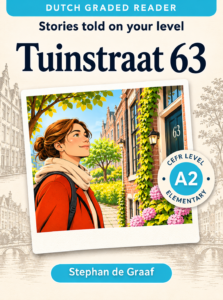 Dutch graded reader · A2 Tuinstraat 63 A new home,… Read more: Tuinstraat 63
- Gysbrecht vn Amstel
 Discover Joost van den Vondel’s famous tragedy in clear, modern Dutch. Experience a story of power, loyalty and the fate of Amsterdam.
- De Stille Kracht
 Otto van Oudijck gelooft in regels en duidelijke antwoorden. Maar in zijn huis op Java gebeuren vreemde dingen. Geheimen komen dichterbij en zijn vertrouwen begint te verdwijnen.
- O Homem que Sabia Javanês
 Um jovem sem dinheiro encontra uma oportunidade inesperada. Com coragem e muita imaginação, ele inventa uma nova vida. Mas até onde pode chegar uma mentira?